News
Uzbekistan intends to save up to 3.5 billion. cubic meters of water annually due to drip irrigation
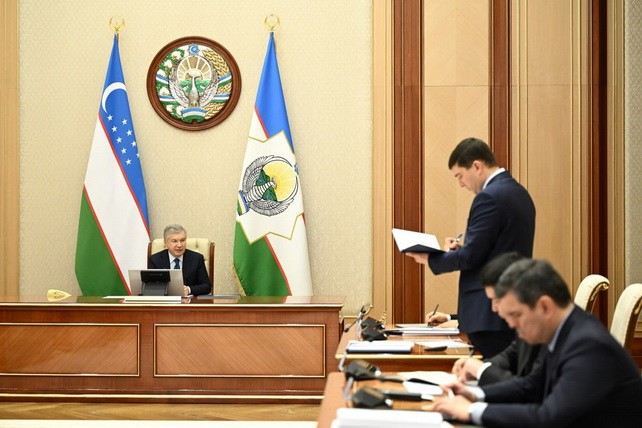
On February 3, President of Uzbekistan Shavkat Mirziyoyev reviewed a presentation focused on the efficient use of water resources and the large-scale implementation of water-saving technologies.
Currently, water-saving technologies are applied on 2.6 million hectares of irrigated land, accounting for 60% of the total irrigated area. By comparison, before 2017 such technologies were used on only 19,000 hectares. This allows the country to save around 2.5 billion cubic metres of water annually.
During the presentation, new proposals aimed at further expanding these initiatives were discussed.
By 2028, it is planned to introduce water-saving technologies on an additional 930,000 hectares, increasing the total area to 3.5 million hectares, or 80% of irrigated land.
These measures are expected to save 3.5 billion cubic metres of water annually, improve irrigation on 300,000 hectares, and ensure watering for secondary crops.
The saved resources will be used to guarantee water supply for farmers in water-scarce regions.
New state support mechanisms will be introduced, with tax rates and subsidies determined according to water availability. Projects in areas with unstable water supply will receive subsidies with a 1.25 coefficient.
A support system will also be introduced for farmers implementing water-saving technologies using their own funds without loans.
Under this system, 50% of subsidies will be provided in advance based on project documentation and contractor agreements. Subsidies will also cover fields using drip or discrete irrigation for grain production.
Interest on commercial bank loans for purchasing and installing water-saving systems will be partially reimbursed.
Contractors installing such technologies must provide at least a two-year warranty and five years of service support.
Government oversight will be enhanced through the installation of smart metering devices integrated into the “Suv hisobi” information system.
Inspections will use body cameras and drones to monitor water usage and losses.
The use of traditional irrigation methods on subsidised land with installed water-saving systems will be considered unauthorised water use.
To protect farmers’ interests, state duties will be waived for relevant legal claims.
The President also stressed the need to strengthen human resources in the water sector.
Under the “School of Water Specialists” project, 10,000 farmers will receive training in 2026, while 358 water management experts will study abroad.
The President instructed relevant authorities to implement the measures consistently to ensure sustainable agricultural development through rational water use.
Source
