News
The President reviewed measures to develop hydropower and water infrastructure
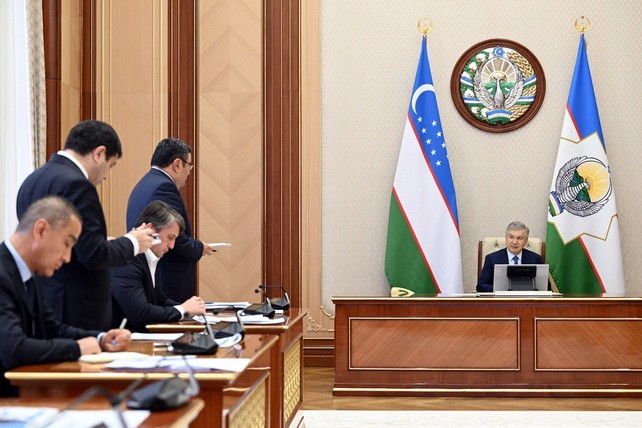
On April 29, the President of the Republic of Uzbekistan Shavkat Mirziyoyev got acquainted with a presentation dedicated to the current results and prospects for the development of the hydropower industry.
As noted, the length of the country’s rivers, canals and other waterways exceeds 150 thousand kilometers, which creates significant potential for the integrated use of water resources - both for water supply and irrigation, and for electricity generation, economic development and environmental sustainability.
Currently, the share of hydropower in the generation structure is about 10–12 percent, while the main volume of production is still provided by traditional sources - natural gas and coal.
In this regard, the strategic importance of the accelerated development of hydropower was emphasized as one of the key factors in strengthening energy security and reducing dependence on fossil fuels.
The industry has made remarkable progress in recent years: the number of hydroelectric power plants has increased from 36 in 2017 to 100 by 2025, and installed capacity has increased from 1.6 to 2.4 gigawatts. The UzHydroPower plant was put into operation, becoming the only enterprise in Central Asia for the production of hydraulic units and specialized equipment.
At the same time, it is emphasized that a significant part of the hydropower potential remains undeveloped. Taking into account the growth of the economy and population, the task has been set to intensify the use of the energy potential of water resources and accelerate the commissioning of new generating capacities.
During the presentation, plans for the implementation of 73 investment projects with a total value of $5.8 billion in 2026–2032, providing for the creation of additional capacity with a volume of 3.6 gigawatts, were considered. In 2026, it is planned to commission 13 hydroelectric power plants with a total capacity of 114 megawatts with an annual output of 537 million kilowatt-hours, which will also help create new jobs.
Among the priority projects is the construction of the Verkhne-Pskem hydroelectric power station in the Bostanlyk region worth $365 million, with a capacity of 160 megawatts and an annual output of 484 million kilowatt-hours. The implementation of the project will provide electricity to more than 160 thousand households. It is also planned to build the Sokh hydroelectric power station in the Fergana region, which will cover a significant part of the region’s electricity needs.
Particular attention is paid to the development of small hydropower: it is planned to build about 3 thousand small and micro hydroelectric power stations with a total capacity of 164 megawatts, as well as the implementation of projects on the water resources of Upper Tupalang with a potential of over 500 megawatts.
In addition, the prospects for the introduction of pumped storage power plants were considered - the country is working on the construction of three facilities with a total capacity of 1.4 gigawatts. Among the key areas for increasing the efficiency of the industry is the introduction of digital technologies and monitoring systems based on artificial intelligence.
The head of state instructed to ensure the timely implementation of planned projects, increase the level of localization of production and accelerate the implementation of modern technological solutions.
During the presentation, special attention was paid to the development of the coastal areas of the capital. In the city of Tashkent, it is planned to implement projects to create green areas, modernize urban infrastructure and create a favorable microclimate.
In particular, within the framework of the Coastal Zone project, it is planned to improve 306 hectares along the Chirchik River, as well as create a green belt along the Bektemir Canal.
Additionally, a project to create artificial reservoirs in the capital is presented.
The President ordered to increase their number from four to twelve in order to create a comfortable urban environment and improve climatic conditions.
Source
